


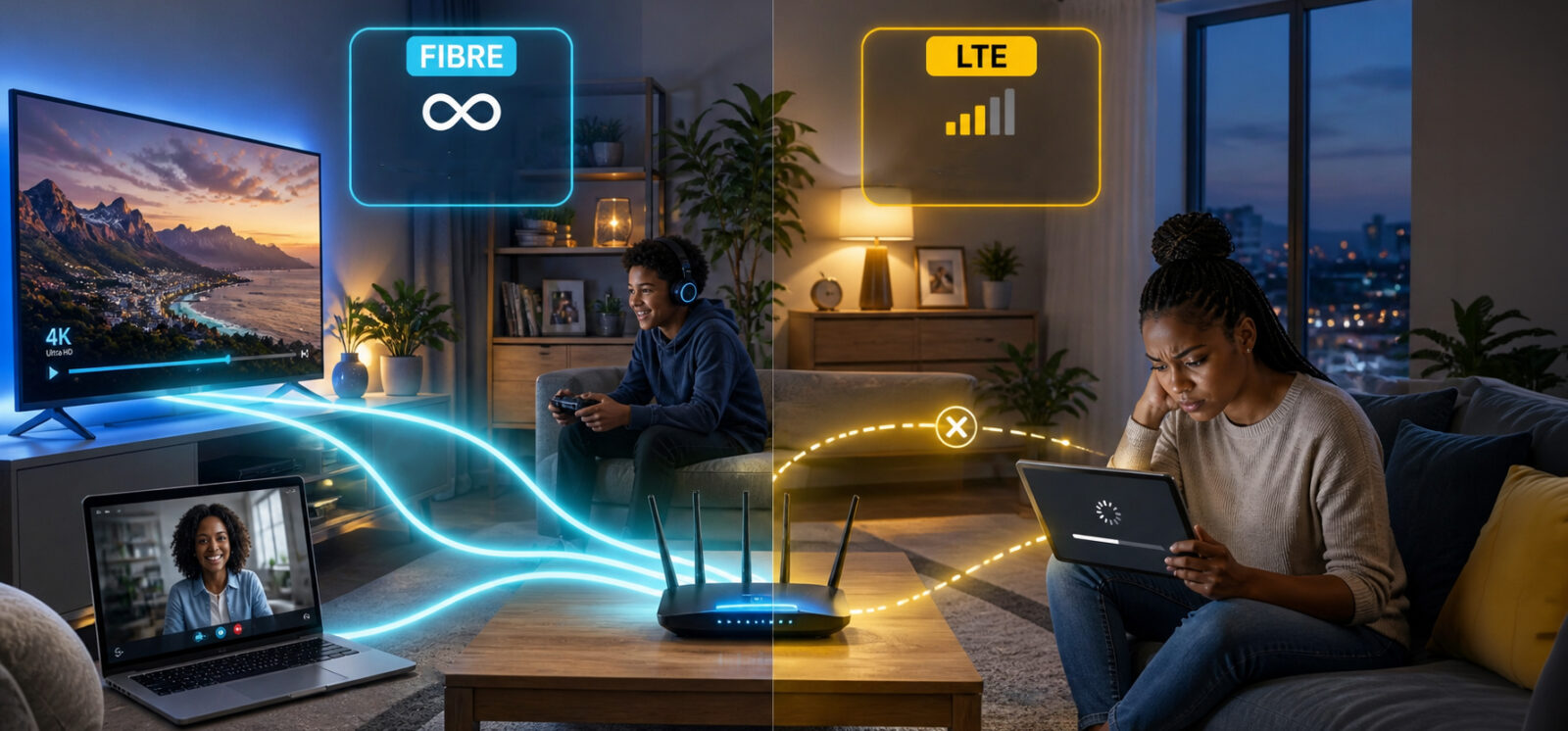
Fibre vs LTE: Which is Better for South Africa?
For most fixed home internet use, fibre is usually the better long-term option where it is available. LTE is not without its merits, and there are genuine situations where it makes more sense. This guide breaks down the real differences between fibre and LTE in South Africa so you can make a proper decision based on what actually matters: speed, reliability, latency, cost, and how your household uses the internet every single day.
Key Takeaway: For most fixed home internet use, fibre offers faster, more consistent speeds, lower latency, and more reliable performance than LTE. LTE can still be a useful option where fibre is not yet available or as a backup. The right choice depends on your situation, usage needs, and what is available at your address.
Who This Guide Is For
This guide is for you if:
- You are deciding between fibre and LTE for your home internet and want the facts, not a sales pitch
- You are currently on LTE or mobile data and wondering if fibre is worth the switch
- You have been told fibre is not available in your area and want to know if LTE is a decent alternative
- You are a remote worker, gamer, or streamer who needs to know which connection type actually delivers
- You just want someone to explain the difference without drowning you in jargon
Whether you are in Joburg, Cape Town, Durban, or a smaller town where both options might be on the table, this guide will sort it out.
How Fibre and LTE Actually Work
Before we get into the comparison, it helps to understand what is going on under the hood. We will keep it simple.
Fibre
Fibre internet uses thin glass or plastic cables buried underground that carry data as pulses of light. These cables run directly from the network to your home, terminating at a small box called an ONT (Optical Network Terminal). You plug your Wi-Fi router into the ONT, and that is your internet sorted.
The key thing about fibre is that it is a dedicated physical line. The cable running into your house is not shared with your neighbours. Your speeds are your speeds, regardless of what is happening on the street, in the complex, or across the suburb.
LTE
LTE (Long-Term Evolution) is mobile internet delivered through cellular towers, the same towers your phone uses. Instead of a physical cable, your connection travels wirelessly from the nearest tower to a router in your home, usually a small box with a SIM card inside.
The problem is that the tower’s bandwidth is shared among every device connected to it. Every phone scrolling Instagram, every other LTE router in the neighbourhood, every car passing through with mobile data on. They are all pulling from the same tower. When the tower gets busy, everyone’s speeds drop.
The Head-to-Head Comparison
Here is where things get real. Let us compare fibre and LTE across the metrics that actually matter for home internet.
| Feature | Fibre | LTE |
|---|---|---|
| Download speed | Consistent speeds based on your selected package | Variable speeds depending on tower load and signal |
| Upload speed | More predictable upload performance | Usually lower and more variable |
| Latency (ping) | Low and stable | Higher and more prone to spikes |
| Reliability | Stable and not affected by tower congestion | Fluctuates with tower load, weather, distance, and time of day |
| Data limits | Unlimited and uncapped with Infini-fi | Often capped, throttled, or subject to fair-usage policies |
| Monthly cost | Fibre pricing changes by package, network and promotion. Check the Infini-fi Deals page for current fibre prices. | LTE pricing varies by provider, data cap and fair-usage rules. |
| Cost per usable GB | Effectively simple to manage when uncapped | Can increase if you need top-ups or larger data bundles |
| Consistency during peak hours | Speeds are more stable | Noticeable slowdowns are common during busy periods |
| Installation | Requires physical installation | Plug and play, just insert SIM and power on |
| Portability | Fixed to one address | Can move it between locations |
| Affected by loadshedding | ONT and router need power | Router and tower infrastructure need power |
| Best for | Streaming, gaming, work from home, families, smart homes | Temporary setups, light use, or areas without fibre coverage |
That table tells most of the story, but let us dig into the details that really matter.
Speed: Not Just About the Numbers
LTE providers love throwing around big numbers. “Up to 150 Mbps” they will shout on the box. And technically, ja, LTE-Advanced can theoretically hit those speeds. But here is the thing: you will almost never see them in practice.
LTE speeds depend on how far you are from the tower, how many people are using that tower, what time of day it is, what the weather is doing, and even what direction your router is facing. You might get strong speeds at 2 AM on a Tuesday and much slower speeds at 7 PM on a Friday. That kind of inconsistency makes it tough to rely on.
Fibre speeds, on the other hand, are based on the package you choose. If your fibre package is designed for a certain download and upload speed, you can expect a far more consistent experience across the day. Your dedicated fibre line does not depend on how many mobile users are connected to the nearest tower.
Bottom line: Fibre gives you consistent, reliable speeds. LTE gives you a range, and that range tends to shrink exactly when you need it most.
Latency: The Hidden Deal-Breaker
Most people focus on speed, but latency is quietly just as important, especially if you game, do video calls, or work from home.
Latency, also called ping, is the time it takes for a signal to travel from your device to the server and back. Think of it as reaction time. Low latency means snappy, responsive internet. High latency means that tiny delay between clicking something and it actually happening.
Fibre latency: usually lower and more stable, which helps video calls, gaming and everyday browsing feel more responsive.
LTE latency: usually higher and more prone to spikes, especially during busy periods or when the signal is weak.
For gamers, this is a big deal. Competitive online gaming on LTE can be an uphill battle. Every time your ping spikes because someone nearby started streaming, you are the one getting outplayed, not because you are slow, but because your connection is. On fibre, your ping is generally lower and more stable.
Bottom line: Fibre gives you the low, consistent latency that makes everything feel more responsive. LTE cannot match that consistency in most fixed home internet situations.
Reliability: The Weeknight Stress Test
Here is a scenario that will sound familiar to many South Africans on LTE: it is 7 PM on a Wednesday. Everyone in your area is home from work. The whole neighbourhood is streaming, scrolling, and downloading. And your internet suddenly feels like wading through mud.
That is tower congestion. LTE towers have a finite amount of bandwidth, and it is split between every connected device in range. The more people online, the less each person gets. Peak hours are often the most frustrating time for LTE connections.
Fibre does not have this problem in the same way. Your dedicated line runs from the fibre network into your home. Whether it is early morning or peak dinner time, your connection is not sharing the nearest mobile tower with every phone and LTE router in the area.
Weather can also affect LTE. Heavy rain, storms, and even strong wind can degrade signal quality and reduce speeds. Fibre is buried underground and is not affected by weather conditions in the same way. The data travels through cables, not through the air.
Bottom line: If you need internet that works consistently every day, fibre is generally the more reliable choice. LTE is inherently less consistent because it shares wireless infrastructure with everyone around you.
Cost: The True Price of “Cheap” LTE
This is where people often get tripped up. An LTE deal can look cheaper at first glance, especially when it is advertised with a low monthly fee. The important thing is to check what you actually get: data allowance, fair-usage rules, throttling, speed consistency and top-up costs.
Most LTE packages come with a data cap. You get a set amount of data per month, and once that is used up, you either get throttled to slower speeds or you pay extra for top-ups. If your household streams regularly, games, or works from home, that data can disappear quickly.
Some providers offer “unlimited” LTE, but read the fine print. There is usually a fair-usage policy lurking in there. Hit a certain threshold and your speeds can get reduced. You are technically still connected, but your once-usable connection may suddenly feel frustrating.
With Infini-fi fibre, packages are designed around uncapped home internet. That means you do not need to manage your household around a mobile-data allowance. Stream, game, browse, download and work without counting every gigabyte.
Real-World Cost Comparison
| Scenario | LTE | Infini-fi Fibre |
|---|---|---|
| Monthly cost | Varies by provider, data cap and promotion | See the current Infini-fi Deals page for the latest uncapped fibre pricing |
| Data allowance | Often capped, throttled, or subject to fair-usage policies | Uncapped home fibre |
| Streaming | Limited by data allowance or fair-use rules | Better suited to regular streaming |
| Game downloads | Large downloads can quickly use up capped data | Better suited to large downloads and updates |
| Hidden costs | Top-up data, larger bundles, or overage costs may apply | Pricing is clearer when you choose the right package upfront |
When you break it down like that, fibre often makes more sense for households that actually use the internet every day. The best approach is to compare the latest fibre packages on the Infini-fi Deals page against the true cost of the LTE package you are considering.
An entry-level uncapped fibre package can often offer better long-term value than capped LTE, especially when several people are streaming, working, browsing or gaming in the same home. Check the latest Infini-fi fibre deals for current package pricing.
Bottom line: LTE can look cheap until you actually use it. Fibre gives you a clearer monthly cost and removes the stress of running out of data.
When LTE Actually Wins
We would be lying if we said fibre is always the answer. There are legitimate situations where LTE makes more sense.
Fibre is not available yet. If fibre has not reached your street, LTE can be a reasonable stopgap. Check your coverage and register your interest so you know when fibre becomes available.
You are renting short-term. If you are in a place for a short time and there is no existing fibre installation, an LTE router may be quicker to set up.
You need a portable solution. LTE routers can move with you. If you travel between properties or need internet at a holiday home, LTE’s flexibility is a genuine advantage.
Your usage is genuinely light. If you live alone, barely stream, and mostly just browse and check emails, a small LTE package might cover your needs affordably. But the moment a second person starts using the connection or you start streaming more often, you may feel the limits quickly.
For most households with regular internet use, fibre is generally the better choice where it is available.
When Fibre Wins, Which Is Most of the Time
Working from home. Stable, low-latency connections mean your video calls are less likely to freeze mid-presentation.
Streaming. Fibre is better suited to Netflix, Showmax, YouTube and other streaming services across multiple screens.
Gaming. Lower latency, more stable speeds and faster downloads make online gaming smoother.
Families. Everyone can be online at the same time without the “who is hogging the internet” argument.
Smart homes. Security cameras, smart doorbells, smart speakers and other connected devices all work better with a reliable home connection.
Content creation. Stronger upload performance helps when you need to upload files, videos or backups.
Peace of mind. No mobile-data cap to worry about, fewer peak-hour slowdowns, and a clearer internet experience for the household.
The Infini-fi Advantage
Choosing fibre is step one. Choosing the right ISP is step two, and this is where we come in.
Built on Maziv Infrastructure
Infini-fi operates on established South African fibre infrastructure designed for high-speed internet. When you connect with Infini-fi, you are not relying on a mobile tower for your everyday home connection. You are using a fixed fibre connection designed for households that need reliable internet.
Netflix Peering
Here is something most ISPs do not talk about, and we think you should know. Infini-fi benefits from Netflix Open Connect peering through the fibre network infrastructure. What does that mean in plain English? Netflix has servers placed closer to the network, so when you hit play on a movie, the data does not need to travel as far to reach your screen.
The result is faster loading times, less buffering, and a better streaming experience, especially for households that stream often.
Genuinely Uncapped
Every Infini-fi home fibre package is designed for uncapped household use. No mobile-data meter. No constant checking how much data is left. Use your connection for streaming, working, browsing, gaming and downloading without managing your month around a cap.
Flexible Options
Infini-fi offers fibre packages designed for different households and usage needs. Whether you are comparing entry-level options, higher-speed packages, or contract and month-to-month choices, the current Deals page is the best place to check what is available now.
Real People, Real Support
Got a question? Call us on 084 555 8858 and talk to an actual human being. We are a South African team helping South African households get connected properly.
5 Key Points to Remember
- Fibre delivers more consistent speeds than LTE because it does not rely on a shared mobile tower in the same way.
- Latency matters more than many people think. Fibre is usually better for gaming, video calls and responsive browsing.
- “Unlimited” LTE is not always the same as uncapped fibre. Always check fair-usage and throttling rules.
- Fibre can offer better long-term value for households that stream, work, game or use many devices.
- LTE is a decent stopgap if fibre is not available yet, but once fibre is available, it is usually the better fixed home internet option.
Frequently Asked Questions
Is fibre really that much better than LTE for home internet?
For most households with regular internet use, yes. Fibre gives you a fixed connection that is more stable than a mobile tower connection. You get more consistent speeds, lower latency and uncapped home internet. LTE shares tower bandwidth with everyone in your area, which means your speeds can fluctuate throughout the day.
Can I game on LTE, or do I need fibre?
You can game on LTE, but you may not enjoy it as much. Online gaming needs low, stable latency more than raw speed, and that is exactly what LTE can struggle to deliver. Your ping on LTE can spike in the middle of a match because the tower is busy or your signal changes. Fibre is usually the better option if gaming matters to you.
Why does LTE slow down in the evening?
LTE towers have limited bandwidth, and it is shared among every device connected to them. In the evening, most people are home and online, streaming, scrolling and downloading. The tower has more demand to handle, so speeds can drop. Fibre does not rely on the same mobile tower capacity in your area.
Is fibre more expensive than LTE?
Not always. A basic LTE deal might look cheaper, but it often comes with a data cap, fair-usage rules or throttling. Once you hit the limit, you may need top-up data or a larger package. With Infini-fi, package pricing and promotions are kept up to date on the Deals page. The key difference is that fibre gives you uncapped home internet without mobile-data top-ups or LTE-style data caps.
What happens to my fibre during loadshedding?
Your fibre line itself does not need electricity. It is a passive cable. But the ONT box in your home and your Wi-Fi router do need power. During loadshedding, they will go off unless you have a UPS or inverter setup. A small UPS can keep your ONT and router running through most loadshedding stages. LTE routers also need power, so they face the same issue.
Can I switch from LTE to Infini-fi fibre easily?
Absolutely. If fibre is available at your address, you can sign up and schedule an installation. The process is straightforward. A technician installs the ONT box, you connect your router, and you are online. Once your fibre is up and running, you can cancel your LTE contract according to its terms and say goodbye to data caps. For a full walkthrough of what happens on installation day, see our guide on how fibre installation works.
Is 5G better than fibre?
5G is faster than LTE in ideal conditions, but it still faces the same fundamental limitation: it is a shared, wireless connection. Speeds depend on tower proximity, congestion and coverage. In South Africa, 5G coverage is still limited to specific areas and speeds can vary. Fibre remains more consistent, more reliable and generally better suited to permanent home internet. For now, fibre is still the better bet for most homes that can get it.
What if fibre is not available in my area yet?
If fibre has not reached your address, LTE is a reasonable temporary solution. Check your coverage on the Infini-fi website. If fibre is not available yet, you can register your interest and we will let you know when service becomes available in your area. In the meantime, keep an eye on your LTE data usage and consider a package that gives you enough data for your household.
Ready to Make the Switch?
If fibre is available at your address, there is usually a strong reason to switch from LTE. You will get more consistent speeds, lower latency, uncapped home internet and a connection that is better suited to modern households.
Check your coverage on our website to see if fibre is available at your location. If it is, you could be connected soon and wondering why you did not switch earlier.
Got questions? Call us on 084 555 8858. We are real people, and we will help you figure out the best package for your household. Not sure which speed tier you need? Our guide to choosing the right fibre speed breaks it all down.
Infini-fi: uncapped fibre for homes that need internet they can rely on. No mobile-data caps. No LTE-style top-ups. No nonsense.
For more fibre guides and resources, visit the Infini-fi Knowledge Hub.
Ready for the next step?
Find a deal that suits your lifestyle, or head back to the Knowledge Hub for more fibre help, FAQs and practical advice.