


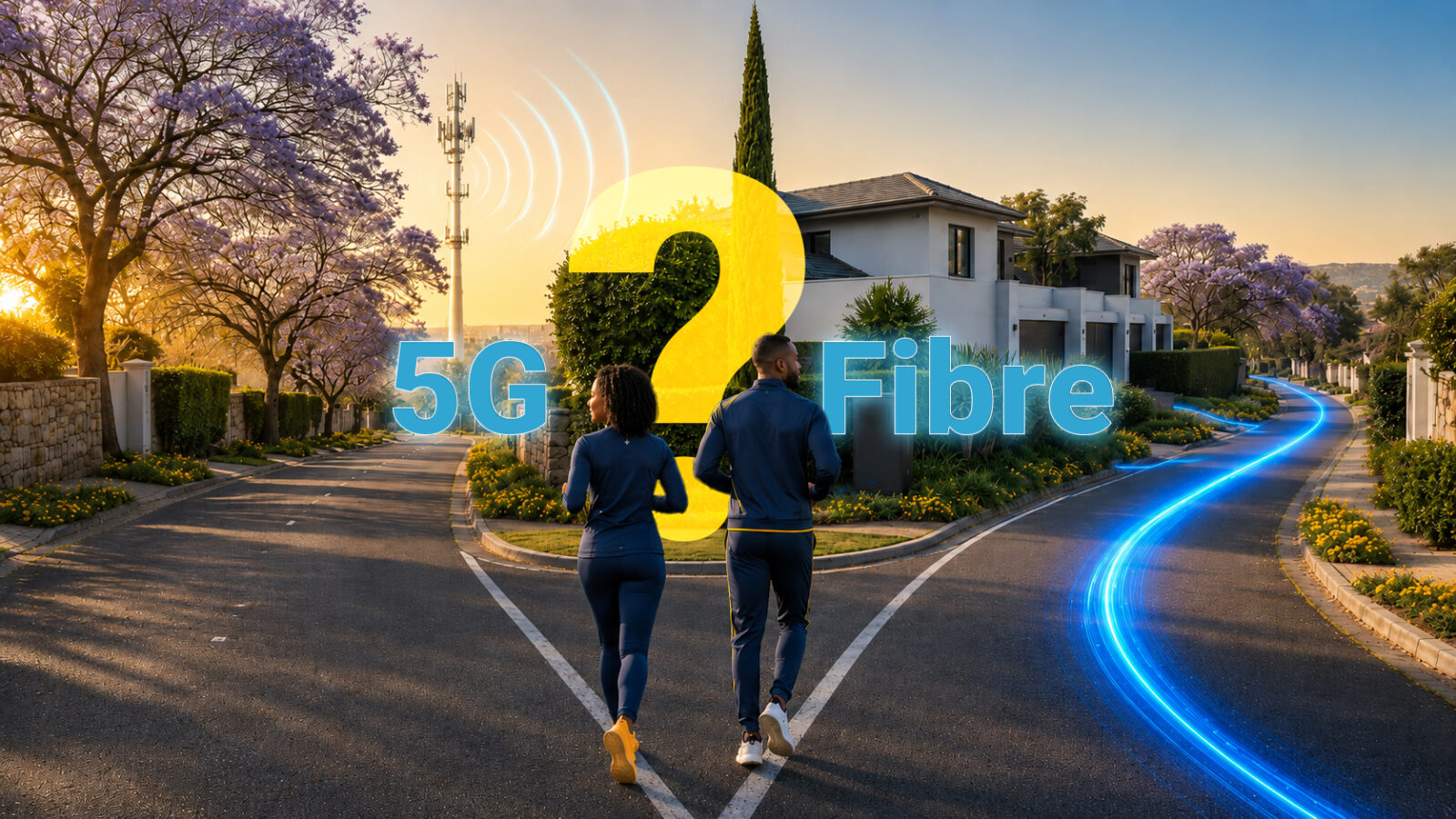
Fibre is generally the more consistent option for South African homes, because it runs on a fixed line rather than a shared mobile tower. 5G can match or beat entry-level fibre speeds where coverage is strong, but performance depends on tower congestion, distance and load. The better fit depends on your address, household size and how you use the internet day to day.
Fibre vs 5G at a glance
| What matters | Fibre | 5G |
|---|---|---|
| Stability | Generally more stable, since it runs on a fixed line rather than shared tower capacity. | Can vary with signal strength, tower load and location. |
| Speed | Typically consistent across the day for home use. | Can be very fast in strong-coverage areas, but fluctuates with congestion. |
| Latency & jitter | Usually lower and more stable, which matters for gaming and calls. | Generally higher and more variable than fibre, though this narrows with strong signal. |
| Upload speed | Often matches or nears download speed on symmetrical packages. | Typically well below download speed, which matters for calls and uploads. |
| Setup | Needs fibre coverage at your address and installation. | Usually quicker to start, often self-install. |
| Portability | Fixed to one address. | Easier to move between addresses. |
| Best fit | Long-term home internet for streaming, work, study and gaming. | Backup, temporary use, or homes without fibre yet. |
What the South African data actually shows
Before you compare fibre and 5G, it helps to look at what is actually happening in South Africa, not just what the package promises.
Mobile coverage is broad, but 5G is still not everywhere. ICASA’s (Independent Communications Authority of South Africa) latest figures show that 4G/LTE reaches almost the whole population, while 5G coverage is growing quickly, moving from 46.6% to 58% in one year. That is a big jump, but it doesn’t mean every area has the same 5G experience. Rural coverage still lags behind urban areas, with some provinces sitting as low as 7% rural 5G coverage.
Fibre is growing too. ICASA reports that fixed broadband subscriptions increased from 1.4 million in 2023 to 2.7 million by the end of 2024, largely driven by fibre-to-the-home and fibre-to-the-building rollout.
Speed tests also show why 5G gets attention. In strong coverage areas, independent Ookla data shows that 5G can reach download speeds of around 170 to 230 Mbps on some networks, with latency around 36ms. That is genuinely fast, but those results reflect good conditions. They’re not a guarantee of what every household will get at every address.
The real takeaway is this: 5G is expanding quickly and can perform well, but coverage and consistency still depend heavily on where you live. “5G is available in my area” and “5G performs well at my exact address” are not always the same thing.
What is the difference between fibre and 5G?
Fibre internet uses fibre-optic cables to connect your home to the network. It is a fixed-line connection, delivered through physical infrastructure installed at your property.
5G is a wireless mobile internet technology that connects your device or router to the internet through nearby mobile towers. It is the generation after LTE/4G and can deliver faster speeds where coverage is strong.
The core difference: fibre is fixed to your home, while 5G depends on wireless signal from a tower shared with everyone nearby. That sharing is why 5G performance typically varies more than fibre. It depends on how many people are using the same tower, how far you are from it, and what's between you and it.
Why fibre is generally more consistent than 5G
5G can look excellent on a single speed test. The question is what happens when the tower gets busy. Because mobile internet is shared infrastructure, speeds during peak hours can differ noticeably from speeds at 10am, simply because more devices are pulling from the same tower at once.
Fibre is less exposed to this specific problem, because it doesn't share capacity with a tower. A 50 Mbps fibre line will generally feel close to 50 Mbps whether it's 10am or 7pm — though fibre performance can still be affected by faults, network congestion further upstream, poor in-home Wi-Fi, or router placement, so "fixed line" doesn't mean "immune to every issue."
Latency, jitter and packet loss, not just download speed
Download speed gets most of the attention, but three other numbers matter more for how your internet actually feels day to day:
Latency: the delay between an action and a response. This is what you feel as lag in games or a delay in video calls.
Jitter: how much that delay varies from moment to moment. High jitter is what causes choppy audio or video even when the average speed looks fine.
Packet loss: data that doesn't arrive at all and has to be resent, which shows up as stutters, frozen frames or dropped calls.
Fibre generally performs better on all three because it isn't sharing wireless spectrum with other users. 5G has improved substantially on this front compared with LTE. It uses more spectrum and is built for lower latency, but it still shares the same underlying constraint: performance depends on tower capacity, signal strength and distance from the tower.
It's also worth separating your internet connection from your home Wi-Fi network. A strong fibre or 5G connection can still feel slow if your router is old, poorly placed, or overloaded with connected devices. That's a Wi-Fi problem, not an internet problem.
What happens during peak usage times?
Most households notice internet problems in the evening, when people stream, scroll, game, join calls and download updates at the same time. On 5G, this is when tower congestion is most likely to affect speed. This is one reason fibre tends to hold up better for households where several people are online at once.
Power interruptions and local outages
Power issues in South Africa aren't limited to scheduled loadshedding. Some areas also see unplanned outages or maintenance interruptions. For 5G, the practical concern is the tower: backup power capacity, if any, varies by site and provider, and towers can come under more pressure during widespread outages. For fibre, your home connection can often keep working through a short interruption if your ONT (Optical Network Terminal) and router are on a UPS or other backup power, though this depends on your specific fibre network and setup, and isn't guaranteed. Neither technology is immune to outages; the exposure is just different.
Choosing by household type
The right answer often comes down to what your household actually does, not just which technology is theoretically faster. A rough guide:
| Household type | Generally better fit | Why |
|---|---|---|
| Remote worker on daily video calls | Fibre | Lower, steadier latency and jitter reduce call drops and lag. |
| Competitive or fast-paced gamer | Fibre | More consistent ping with fewer spikes during peak hours. |
| Family with multiple streams/devices | Fibre | Fixed-line capacity handles simultaneous use without tower contention. |
| Temporary rental / short stay | 5G | No installation wait, easy to set up and move. |
| Home without fibre coverage yet | 5G | Often the only realistic option until fibre reaches the street. |
| Home that wants backup connectivity | Both: fibre as primary, 5G as failover | 5G on a separate network path keeps you online if the fibre line faults. |
Cost and package terms: What to actually compare
Headline price alone doesn't tell you much. Entry-level 5G plans can look cheaper upfront, but many carry fair usage policies that throttle speed after a data threshold, so check the actual terms, not just the monthly figure, before comparing cost. Fibre pricing is generally more transparent month-to-month for uncapped packages, but may involve installation or activation costs depending on the provider or promotion.
| Fibre | 5G | |
|---|---|---|
| Typical monthly range | Varies by speed tier and area, check current deals | Often positioned as cheaper entry-level pricing |
| Data limits | Uncapped is the norm on standard residential fibre | Data itself often uncapped, but fair usage policies can throttle speed after a threshold |
| Once-off costs | Installation/activation may apply depending on promotion | Often minimal: self-install, no technician visit |
| Router | Frequently included free-to-use on standard packages | Usually required upfront or bundled into the plan |
Fibre as the main connection, 5G as backup
For some households, downtime is more than just annoying. If you work from home, run a business from home, or have kids who rely on the internet for schoolwork, a backup connection can be worth considering.
In that case, fibre can work well as your main home connection, with a 5G SIM or router kept as backup. Because fibre and 5G run on different infrastructure, an issue with one connection is less likely to affect the other at the same time. So if your fibre line has a fault, your 5G backup can help keep the household online while it gets sorted.
When 5G still makes sense
5G may be a good fit if:
Fibre is not yet available at your address
You need a temporary internet solution
You move often and need portability
You live alone and use data lightly
You mainly browse, email and stream occasionally
You want a backup connection alongside a fixed line
When fibre is the better home internet choice
Fibre tends to earn its place when your home fits several of the following:
More than one person uses the internet at home
You stream HD or 4K content regularly
You work from home
Your children study online
You game, upload large files, or want one predictable monthly bill
How to check fibre coverage in South Africa
Fibre availability is address-specific. One street may have coverage while the next doesn't, particularly in areas where rollout is still expanding. Coverage depends on which fibre network operator (FNO), such as Vuma or Openserve, has reached your street. A fibre coverage check is the first step before comparing packages.
How Infini-fi helps you choose the right fibre package
Infini-fi offers home fibre packages built for everyday South African households, from light browsing to work-from-home setups, gaming and larger connected homes. Infini-fi packages are built around:
Uncapped fibre: no fixed monthly data limit and no overage fees on standard packages
A free-to-use router included, with no rental fees (remains Infini-fi's property while connected)
Month-to-month flexibility with one calendar month's notice to cancel
Packages sized for different household needs
For more detail, read our uncapped vs unlimited internet guide. As with most uncapped services, fair usage terms may still apply in extreme cases, so it is worth reading the current package terms before signing up.
Frequently Asked Questions
Does 5G still work during loadshedding?
5G depends on the nearby tower having power. Backup capacity varies by site and provider, and towers can come under more pressure during extended or back-to-back outages. Your own 5G router will also need its own power source, such as a UPS, to stay online.
Is 5G good enough for online gaming?
5G can work for casual gaming, particularly with strong signal and low tower congestion. For competitive or fast-paced gaming, fibre is generally the safer choice because of its lower, more consistent latency and reduced risk of ping spikes.
Is 5G cheaper than fibre in South Africa?
It depends on the specific package. Entry-level 5G plans can look cheaper upfront, but many include fair usage policies that slow speeds after a data threshold. Uncapped fibre packages are often better value for households using the internet daily without wanting to track a data limit, but always compare current, actual pricing rather than headline figures.
Can I use 5G as a temporary option while I wait for fibre to reach my street?
Yes, this is one of the most common reasons households choose 5G. It gets you online without an installation wait. Once fibre becomes available, many households switch over for the steadier connection, though it's worth checking your 5G contract terms first to avoid paying for two connections longer than needed.
Ready for the next step?
Find a deal that suits your lifestyle, or head back to the Knowledge Hub for more fibre help, FAQs and practical advice.